Authenticity in Design: US Civil War Digital Paper Backgrounds
When you are working on a project that requires historical weight, modern vector graphics often fall flat. There is a specific texture to history—a sense of age, grit, and imperfection—that is difficult to manufacture from scratch. This is where the value of high-quality design assets becomes evident. Specifically, US Civil War Digital Paper Backgrounds offer a unique solution for creators who need to evoke the mid-19th century without spending hours applying filters or hunting for public domain scans that are often low resolution.
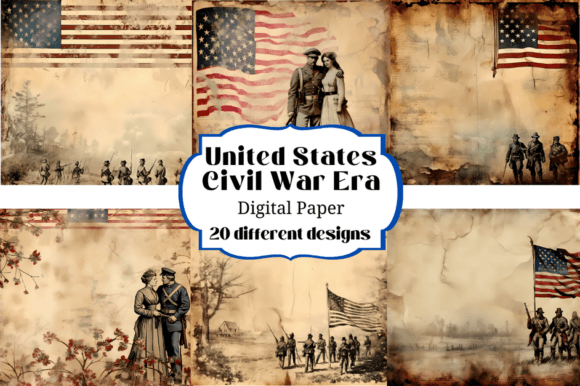
This collection consists of twenty distinct illustrations, designed to function as seamless digital paper. For designers, scrapbookers, and content creators, these files provide a foundational layer for visual storytelling. Whether you are building a brand identity for a historical society, designing packaging for artisanal goods, or creating a junk journal, the background sets the emotional tone before a single word of text is read.
Visual Characteristics and Historical Texture
The appeal of these US Civil War Digital Paper Backgrounds lies in their ability to mimic the tactile qualities of the 1860s. Visually, you are looking at a palette that leans heavily into sepia tones, muted earth colors, aged parchment yellows, and the faded ink blues characteristic of the era. The "personality" of these backgrounds is one of authenticity and seriousness. They are not pristine; they are worn, creased, and textured.
From a design perspective, these backgrounds act as a complex serif font. Just as a serif typeface guides the eye and suggests tradition, a textured background frames the content. The visual noise in these PNG files—subtle stains, paper fibers, and uneven edges—adds a layer of realism that digital-only designs often lack. This is not just "old paper"; it is a representation of history that includes the visual artifacts of time. For a graphic designer, this means you do not have to do heavy post-processing to make the image look realistic. The 300 DPI resolution ensures that these textures remain crisp even when printed, avoiding the pixelation that plagues lower-quality digital downloads.
Strategic Applications for Modern Creators
Understanding where to deploy these assets is key to their effectiveness. While the obvious use case is historical reenactment materials, the versatility of US Civil War Digital Paper Backgrounds extends much further into modern commercial design.
Editorial and Publishing Design
For publishers and authors, these backgrounds are invaluable for book covers, chapter headings, and interior page designs. If you are writing historical fiction or non-fiction, using these textures in your editorial design creates an immediate visual contract with the reader. It signals the genre before they read the title. Furthermore, for scrapbooking and junk journaling, these files serve as the canvas. Because they are provided as separate PNG files in a zip, you can layer them easily in software like Photoshop or Canva, treating them as a base layer for photos and typography.
Digital Marketing and Social Media
In the realm of digital marketing, standing out in a feed is about texture and depth. Flat colors are ubiquitous, but a textured background adds sophistication. For a history podcast, a museum’s social media graphics, or an antique dealer’s Instagram, these backgrounds provide a cohesive aesthetic. They can be used behind quotes, event announcements, or product showcases. The gritty texture contrasts beautifully with clean, modern sans serif fonts, creating a dynamic visual hierarchy that draws the eye to the message.
Branding and Packaging
For small business owners, particularly those in the "maker" space—distilleries, leatherworkers, or bespoke tailors—these backgrounds can influence brand perception. Using a Civil War-era texture in your packaging design suggests craftsmanship, durability, and heritage. It tells a story of endurance. It implies that the product inside is made with the same care as items from a bygone era. This is a subtle form of brand strategy that builds trust with a discerning audience.
Technical Utility and Workflow Integration
One of the most practical aspects of this collection is the file format and delivery. As a digital download, the workflow is immediate. The files are delivered as PNGs, which is the industry standard for transparency and quality. Unlike JPGs, PNGs allow for cleaner layering if you need to isolate specific elements, though these are designed as full backgrounds.
The fact that they are 300 DPI is critical. In web design, 72 DPI is sufficient, but for print, anything less looks blurry. These assets are print-ready. Whether you are printing a large format poster or a small business card, the integrity of the texture holds up. This makes them a premium font equivalent for backgrounds—reliable and professional.
Pairing with Typography
When working with such detailed backgrounds, font pairing becomes a strategic decision. You generally want to avoid highly decorative or script fonts that compete with the texture of the paper. Instead, consider using a sturdy display font for headlines—something with high contrast that can punch through the visual noise. For body text, a clean modern typography choice, like a geometric sans-serif, works best to ensure readability. The background provides the "voice," and the typography provides the "volume."
Practical Considerations for Selection
When evaluating if these US Civil War Digital Paper Backgrounds fit your project, consider the "temperature" of your design. These assets are warm, nostalgic, and organic. If your brand identity is sleek, futuristic, or neon-colored, these might create a dissonance. However, if you are aiming for a vintage, rustic, or "steampunk" aesthetic, they are a perfect match.
It is also worth noting the ease of use. Because the files are named and labeled, you don't waste time guessing which texture is which. For a busy content creator or entrepreneur, efficiency is a feature. You can drag and drop these into your project, resize them to fit your canvas, and move on to the creative work of layout and composition.
Ultimately, these backgrounds are more than just decoration; they are a tool for immersion. They allow you to transport your audience to a specific time and place, adding depth and narrative to your visual communication. Whether for personal art or commercial application, they offer a textured foundation that flat color simply cannot replicate.