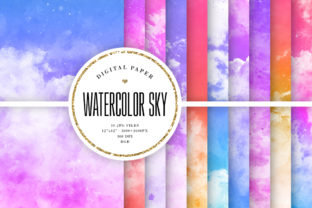
Colorful Watercolor Sky Backgrounds: A Designer's Dream Canvas
There's something about a watercolor sky that stops you mid-scroll. It's not just a background—it's an atmosphere. Colorful Watercolor Sky Backgrounds bring that ethereal, painterly quality to your digital and print projects with the kind of depth and warmth that flat colors simply can't replicate. This collection of 10 JPG files, each at 3600×3600 pixels (a perfect 12"×12" print dimension at 300 DPI), offers a versatile foundation for creators who want their work to feel both artistic and intentional.
The Visual Language of Watercolor Skies
These backgrounds aren't your typical gradient or stock photo. They carry the personality of hand-painted artistry—soft washes of color bleeding into one another, subtle texture from the "paper" beneath, and an organic irregularity that feels human. You'll find sunsets that melt from coral to lavender, twilight scenes where deep blues dissolve into whispers of gold, and morning skies that blend peach and turquoise with a gentle, diffused edge. The RGB color mode ensures vibrant screen display, while the high resolution means they hold up beautifully in print without pixelation or banding.
What makes these assets particularly valuable is their emotional range. A warm, fiery sky can inject energy and passion into a fitness brand's social media graphics. A cool, misty dawn might perfectly complement a wellness blog's header image. The collection gives you options—not just for different projects, but for different moods within the same brand. That flexibility is something seasoned designers constantly look for in premium design assets.
Where These Backgrounds Truly Shine
Let's talk practical applications. If you're building a brand identity, these watercolor skies work exceptionally well behind logo presentations, mood boards, and style guides. They add context and emotion without competing with your typography. Pair a soft sunset background with a clean sans serif font for your brand name, and you've instantly communicated approachability and creativity. For packaging design, imagine a artisanal candle brand using one of these as a sleeve wrap—the tactile quality of watercolor on a physical product creates an immediate emotional connection.
In digital spaces, the applications multiply. Blog headers, podcast cover art, YouTube thumbnails, Instagram stories, and website hero sections all benefit from this kind of textured, atmospheric backdrop. They're especially effective for content creators in niches like travel, mindfulness, art education, and lifestyle branding. The 3600×3600 pixel dimension means you have ample room to crop for various aspect ratios—landscape for website banners, square for social posts, or vertical for phone wallpapers and Pinterest pins—without losing quality.
For entrepreneurs and small business owners, these backgrounds solve a common problem: how to look polished without a design budget. Drop one behind your quote graphics, sale announcements, or event flyers, and the result feels curated rather than generic. They're equally at home in editorial design—think magazine feature spreads, book covers, or digital zines where the sky becomes a visual metaphor for possibility, dreams, or new beginnings.
Making the Most of Your Investment
Before you start layering text and graphics, take a moment to evaluate which sky fits your project's emotional tone. Not every background will work for every purpose. A vibrant, saturated sunset might overwhelm a minimalist brand, while a pale, washed-out dawn could feel too subtle for a bold campaign. Print a few samples if you're working on physical products—colors can shift between screen and paper, even in RGB mode, and seeing the texture at actual size helps you anticipate how it will read in context.
Font pairing is where many creators either elevate or undermine their designs. These watercolor backgrounds have enough visual interest that your typography needs to be intentional. A handwritten font might feel too casual against an already artistic backdrop, creating visual noise. Instead, consider a modern serif for elegance or a geometric sans serif for clean contrast. Test your text at various sizes—what looks good as a headline might become illegible as body copy against the texture. The goal is hierarchy: your message should lead, supported by the background, not the other way around.
Think about consistency across your brand touchpoints. If you're using one sky for your website header, consider how the palette extends to your email templates, business cards, and social media graphics. You don't need to use the same exact background everywhere, but pulling complementary colors from the watercolor washes into your broader color palette creates cohesion. That's the kind of subtle professionalism that builds recognition and trust with your audience over time.
A Few Honest Considerations
These are JPG files, which means they're raster-based and not infinitely scalable like vector graphics. At 300 DPI and 12"×12", they're more than sufficient for most print and digital applications, but if you're planning a billboard or large-format installation, you'll want to test for quality at that scale. For the vast majority of use cases—social media graphics, web design, standard print materials, and even moderate-sized posters—they'll perform beautifully.
The collection gives you 10 variations, which is a solid starting library. Rotate them seasonally across your marketing materials to keep things fresh without straying from your visual identity. Use the warmer skies for summer campaigns and the cooler, muted tones for winter messaging. That kind of thoughtful, seasonal adaptation shows your audience you're paying attention to detail—and that's the hallmark of a brand people remember.
Ultimately, Colorful Watercolor Sky Backgrounds are tools. Like any design asset, their value comes from how thoughtfully you deploy them. Used with intention, they transform ordinary layouts into something that feels crafted, emotional, and unmistakably yours.